W-2 vs 1099: What’s the Difference? (Employee vs Contractor, Taxes & 2026 Changes)
Got a W-2 from one job and a 1099 from another? They’re both tax forms that report what you were paid, but they mean very different things for your taxes. Here’s the difference in plain English.
W-2 vs 1099 at a Glance
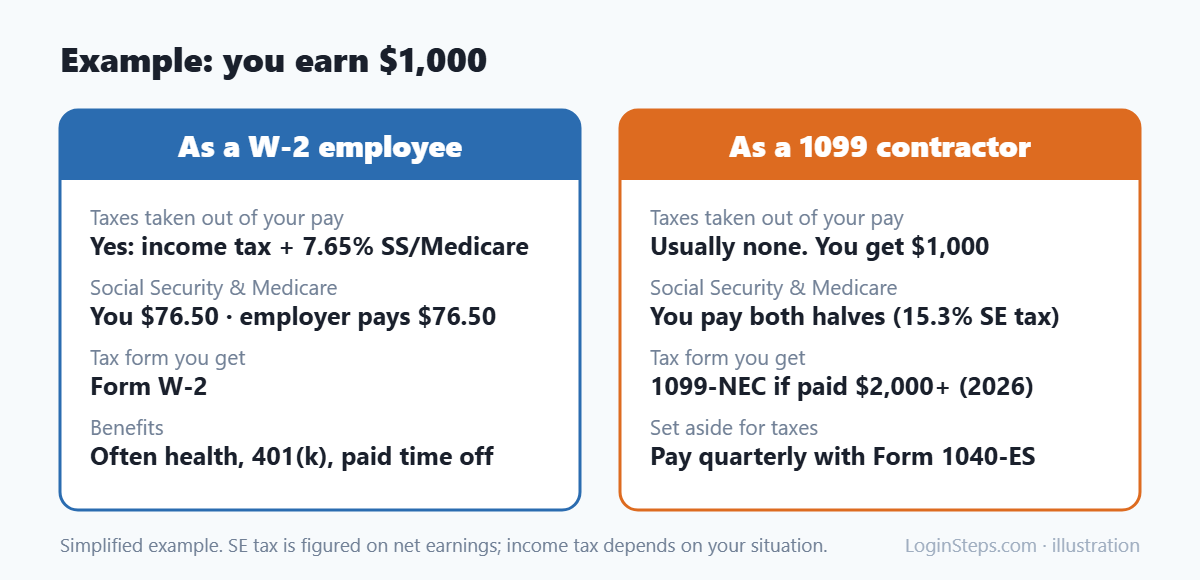
| W-2 (employee) | 1099-NEC (contractor) | |
| Who gets it | Employees | Independent contractors, freelancers, some gig workers |
| Taxes withheld? | Yes: federal, state, Social Security and Medicare | Usually no. You pay your own. |
| Social Security & Medicare | You pay 7.65% and your employer pays 7.65% | You pay both halves (15.3% self-employment tax) |
| Benefits | Often health insurance, 401(k), paid time off | Usually none from the payer |
| Business expenses | Generally not deductible | Can deduct business expenses on Schedule C |
| Due to you by | February 1, 2027 (for 2026) | February 1, 2027 (for 2026 1099-NECs) |
What a W-2 Means
If you get a W-2, you’re an employee. Your employer withholds income tax, Social Security and Medicare from every paycheck based on your Form W-4, and pays its share of payroll taxes. At tax time, your W-2 shows what you earned and what was already paid. See how to read your W-2.
What a 1099-NEC Means
If you get a Form 1099-NEC (nonemployee compensation), a business paid you as an independent contractor. Usually no taxes were withheld, so:
- You report the income on Schedule C and can deduct business expenses.
- You pay self-employment tax on your net earnings, covering both the employee and employer shares of Social Security and Medicare.
- You may need to make quarterly estimated tax payments (Form 1040-ES) during the year to avoid penalties.
New for 2026: The $2,000 Threshold
Businesses used to send a 1099-NEC when they paid you $600 or more in a year. The IRS says that for tax years starting after 2025, the minimum reporting threshold rose to $2,000, with inflation adjustments possible from 2027 (IRS Instructions for Forms 1099-MISC and 1099-NEC).
Important: this only changes when a business has to send the form. All your income is still taxable, even if you were paid less than $2,000 and got no 1099.
Am I an Employee or a Contractor?
It depends on the actual working relationship, not what the company calls you. The IRS looks at three areas:
- Behavioral control: does the company control what you do and how you do it?
- Financial control: who controls how you’re paid, your expenses and your tools?
- Type of relationship: is there a contract, are there benefits, and is your work a key part of the business?
Think You’re Misclassified?
- You or the company can file Form SS-8 to ask the IRS to decide your status. The IRS says it can take six months or more.
- If you believe you should have been an employee, Form 8919 lets you report only the employee’s share of Social Security and Medicare, instead of the full self-employment tax.
Can You Get Both?
Yes. Many people have a W-2 job plus freelance or gig work reported on a 1099. You report both on your tax return. Consider raising the withholding at your W-2 job (Form W-4, step 4(c)) to cover tax on your side income.
Frequently Asked Questions
Is a 1099 worse than a W-2?
Not necessarily. Contractors can deduct business expenses, but they pay more in self-employment tax, handle their own withholding and usually get no benefits.
I earned less than $2,000 and got no 1099. Do I still report it?
Yes. All income is taxable whether or not you get a form.
When do 1099-NECs arrive?
Businesses must send 2026 Forms 1099-NEC by January 31, which moves to February 1, 2027 because January 31 is a Sunday.
Conclusion
A W-2 means you’re an employee with taxes already withheld. A 1099-NEC means you’re paid as a contractor and handle your own taxes, including self-employment tax and estimated payments. From 2026, businesses send a 1099-NEC only for $2,000 or more, but all income still counts.
Related: How to change your W-4 withholding · How to read your W-2
LoginSteps is an independent guide, not a tax advisor. For advice about your own situation, talk to a tax professional or see IRS.gov. Read our disclaimer.